Hej! I know you’ll be wondering about this random title, but you’ll figure it out by the end of the post. This week, the RoFH students went away on their study tour to Italy so the DIS students had to fend for themselves. We got a stipend for food which I spent on cups of noodles, bread, dark chocolate, pears, and jelly. When I caved in and wanted a real cooked meal, I went to this little cafe called Leo’s Wok and ordered takeout. They have some good curries.
I’ll be honest. Nothing much new happened this week(except, one of my friends getting married). In these two weeks between study break 1 and study break 2, a lot of us have been scrambling to complete assignments. I’ll tell you what I’m learning in my classes.
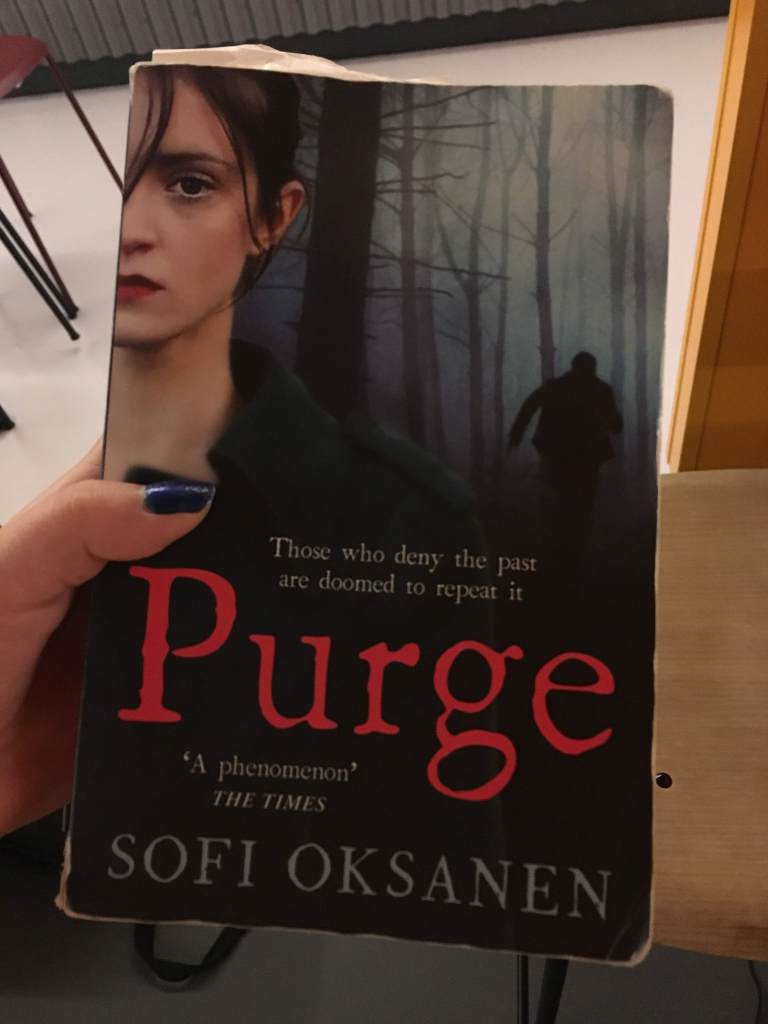
In A Sense of Place in European Lit, we are reading a historical fiction novel, Purge by Sofi Oksanen which tells the history of Soviet-occupied Estonia from the point of view of women. An Estonian woman, Aliide, finds a Russian girl in the forest named Zara. The reader learns about Zara’s past in 1990’s Estonia and Berlin and Aliide’s past in 1940’s Estonian Soviet Socialist Republic. The book is very intense and disturbing at times. I’m glad to be learning a little about this period in Estonia’s history.
Postcolonial Europe: We watched Gold Coast (Guldkysten) with it’s very problematic depictions of Danish colonizers and enslaved Africans. We had a discussion the next class about the imagery in screenshots and depiction of African women in the movie. Even though the movie was made in 2015, it still portrays a romanticized era of Danish colonization on what used to be the Gold Coast.
Danish Language and Culture: We are on the family unit in the language part of the class. Jeg har en lillesøster means I have a little sister. In the culture unit, we are learning about the welfare system and Janteloven, which is like a code of conduct. I learned that around 1810, Danish peasants made an insurance system among themselves. If one person’s house burned down, they had gambling parties to raise money to build a new one. Denmark’s society and the welfare system are built on years of trust between citizens. Of course, this concept is not perfect. With the increasing immigration, there are some people who think that immigrants (especially those from non-Western countries) don’t share the same values as Danes. They expect immigrants and refugees to assimilate to Danish culture and learn the language so that they can contribute to the welfare system. I see parallels to nationalistic and xenophobic rhetoric in the U.S. as well. I’m going to write another post expanding on xenophobia and free speech in Denmark in comparison to the U.S. later.
Janteloven is a fascinating concept that has a different meaning to different individuals. It’s a national code of conduct–which originated from a work of satirical fiction written in 1933–that manifests in various ways in people’s lives. The first law is “You shall not believe that you are somebody.” If someone came up to me and said, “What makes you think you’re somebody?” I would get very offended. You can see how that would be controversial. This is another topic I want to expand on in a future post.
Creative Nonfiction Workshop: We had an assignment to observe someone performing a skill and then write about it. We had to turn in this piece to get the instructions for the next assignment which was to interview that person. Our teacher, who is a journalist, told us that she uses the app called Otter for interviews. It transcribes almost everything and you can go back and listen to the audio. It’s so useful! The third assignment is to write a short non-fiction piece about my person and their skill. I would not put these instructions in the blog post if this workshop wasn’t going to be discontinued after this semester.
Gender and Sexuality in Scandinavia: We learned about gender equality and race in relation to the welfare state. Even though people point to Scandinavian countries as the leading countries in the world for gender equality, the system has its problems. Even though couples receive generous leave time after having a child, women are still overwhelmingly the ones to stay home. Women are less likely to have higher positions in businesses. In addition, immigrant women are expected to contribute to the welfare state. In order to get a job, they need to know Danish. In another one of our readings, a man who was born in Denmark to Pakistani immigrants does not feel Danish because the Danish government’s policies target Muslims, making them feel unwelcome.
That turned out to be a lot longer than I thought it would be. Here are some highlights from the week:

I went with my friend to a monthly event in the Meatpacking district called QueerCuts. People can go there to get their hair cut and or nails painted. Our friend said that queer people can go to QueerCuts for a community without beer and partying. Even though we did not get haircuts, we met some nice people and got our nails painted. My friend asked about the queer scene in Copenhagen, and someone said that it’s very divided. They said that there’s a cisgender queer scene and a trans queer scene. They said that they would feel unwelcome in a gay bar. Speaking of, there are so many gay bars but only one lesbian bar.
On Friday night, my friends had a wedding-themed party. Guests picked out wedding roles such as bride, groom, best man, drunk uncle and we had a wedding at the end of the party. The bride and groom exchanged vows picked out of a fishbowl, there were objections to the marriage, then they got “married.”
Back to homework for me!
Hej hej!
 A North Carolinian in Copenhagen